Fossil Cliffs Walk On Maria Island: Distance, Grade And Guided Walk Stops
The Fossil Cliffs circuit is one of the two signature short walks from Darlington, a 4.5 km Grade 3 loop that packs 300-million-year-old fossils into a circuit most day visitors finish comfortably between the ferry sailings.
Short answer
The Fossil Cliffs walk is a 4.5 km Grade 3 circuit from Darlington taking 1 to 2.5 hours on foot, or 1 to 1.5 hours by bike. The fossils in the cliff face are about 300 million years old. It combines readily with the Darlington Township Walk or, on a longer day, the Painted Cliffs.
How Long Is The Fossil Cliffs Walk And How Hard Is It?
The Fossil Cliffs walk is a 4.5 km circuit rated Grade 3, taking between 1 and 2.5 hours on foot from Darlington. Grade 3 means formed tracks with some steps and short steep sections, suited to most visitors with basic fitness. The same circuit takes 1 to 1.5 hours by bike, and Parks lists both walking and riding times for every track on the island.
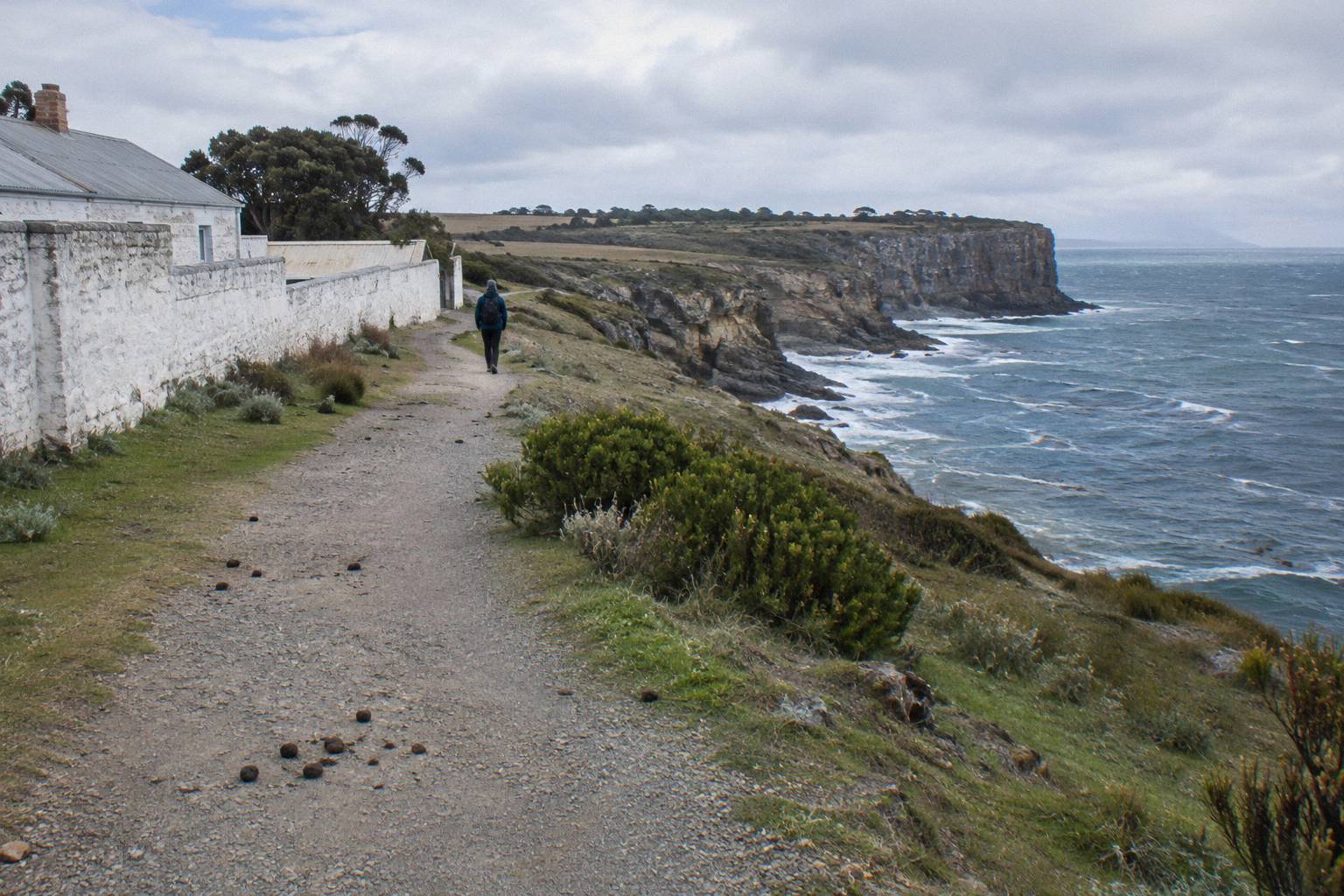
The circuit starts and finishes at Darlington, the small heritage settlement where every ferry and cruise arrival lands. That makes it one of the most practical walks on the island: you step off the jetty, and within a few minutes you are on a track that loops out along the eastern shoreline. The full distance is 4.5 km, which Parks lists as a circuit rather than a return walk, so you see the coastline on the way out and inland ground on the way back.
Grade 3, in the Australian Walking Track Grading System, sits in the middle of the scale. Expect a mostly formed surface, some steps, occasional short climbs and sections that can be uneven or muddy after rain. It is not a scramble. Visitors who walk regularly will find it straightforward, and families with school-age children manage it routinely in the warmer months. If you want a sense of how it compares with the other tracks, the guided and self-guided walking options on Maria Island cover every track from the easy township stroll to the 16 km Mount Maria return.
Parks and Wildlife Service publishes the track details, times and grades for all Maria Island walks on its Maria Island National Park page, and those figures are the ones to plan around. Treat the 1 to 2.5 hour range as real: the fast end belongs to a brisk walker who stops for nothing, while the slow end is a family pace with plenty of pauses at the cliff edge.
| Fossil Cliffs fact | Figure |
|---|---|
| Distance | 4.5 km circuit |
| Grade | Grade 3 |
| Walking time | 1 to 2.5 hours |
| Riding time | 1 to 1.5 hours |
| Start and finish | Darlington |
| Fossils | About 300 million years old |
| Track type | Formed circuit, some steps and short steep sections |
What You Actually See On The Fossil Cliffs Circuit
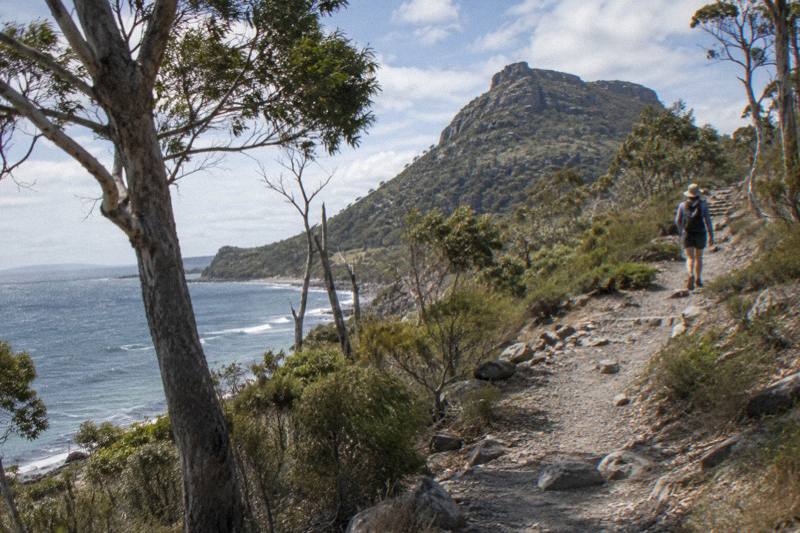
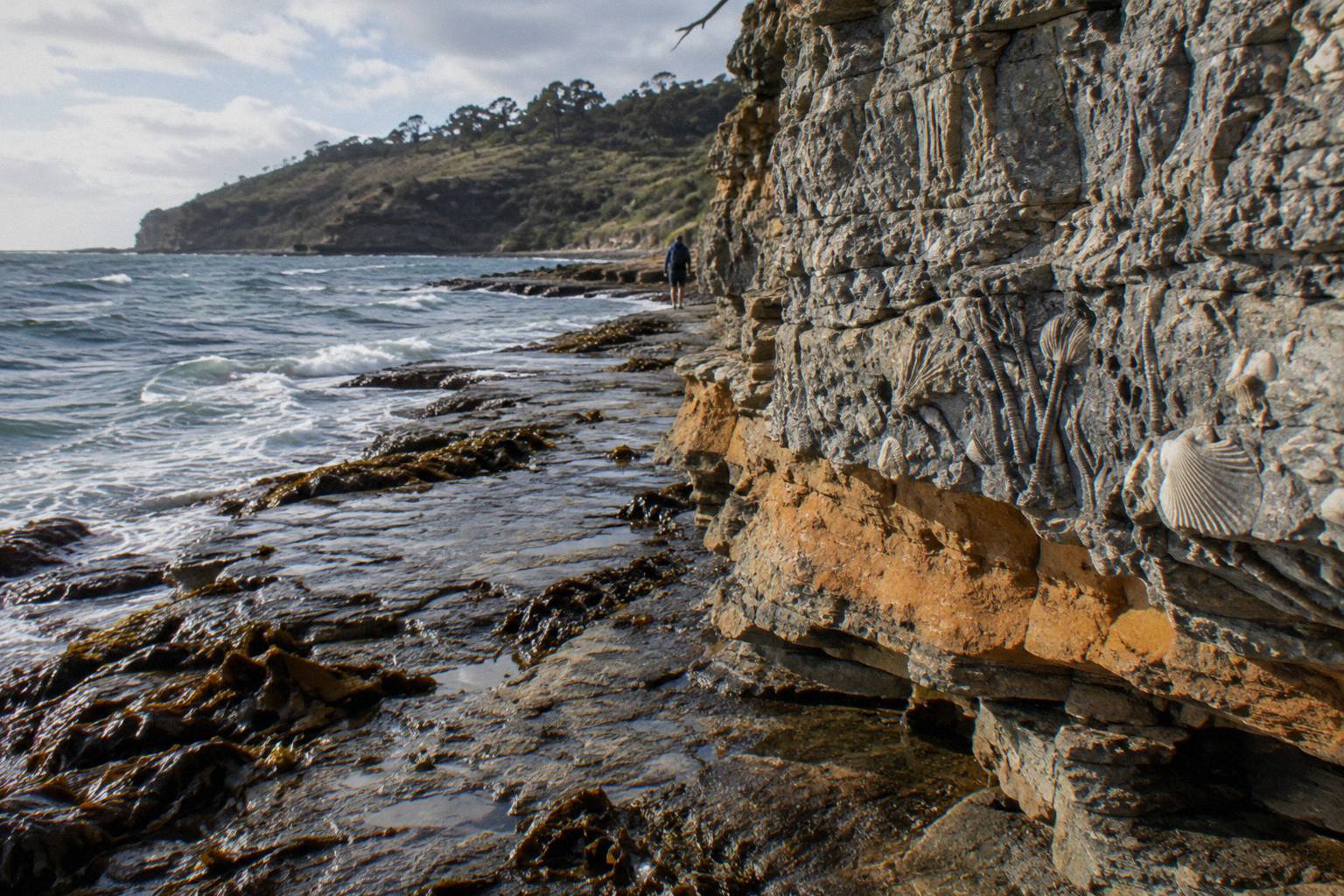
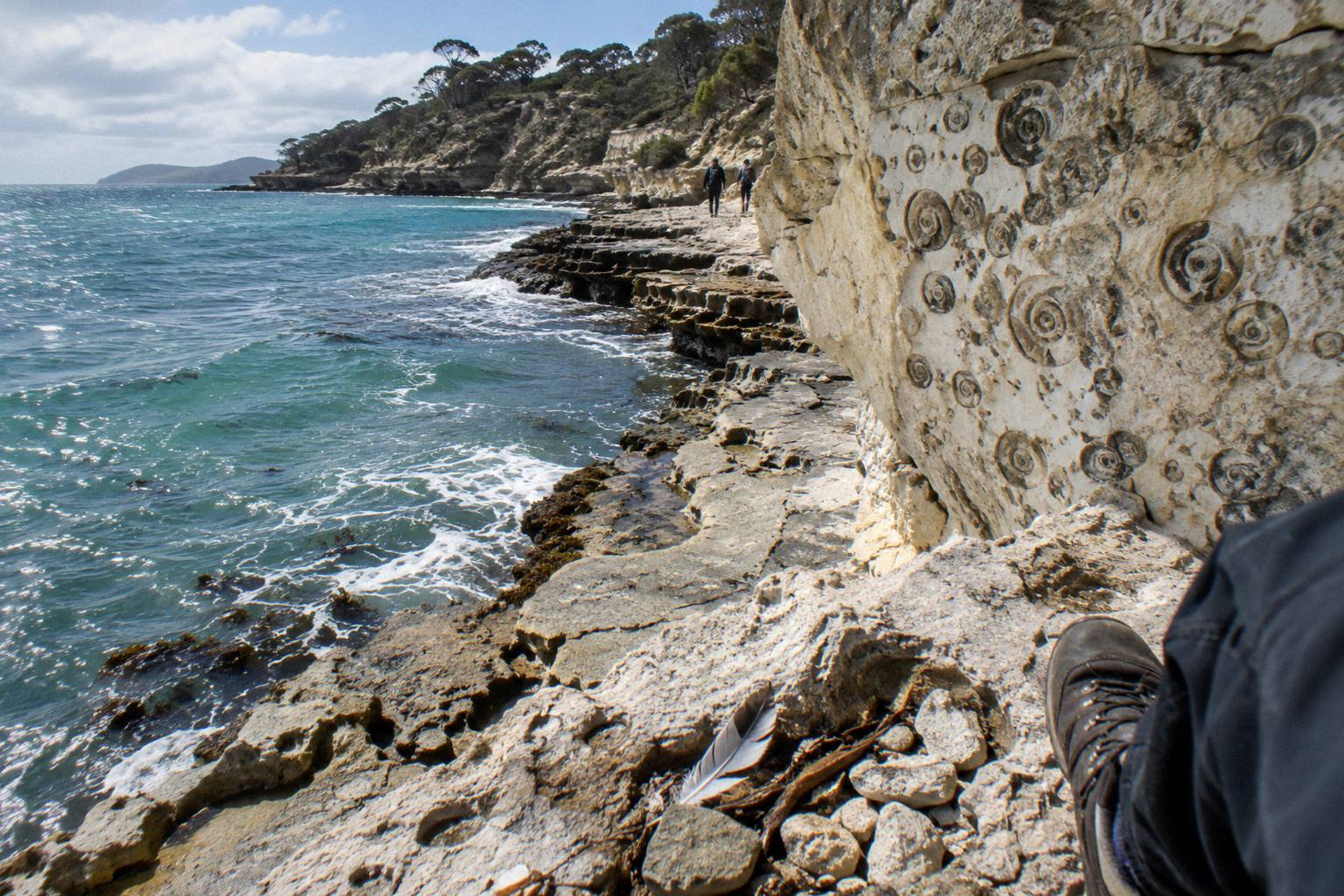
The walk's namesake is a cliff face packed with marine fossils around 300 million years old, exposed along the shoreline below the track. Beyond the fossils themselves, the circuit passes open coastal ground with sea views east, then returns through quieter inland sections toward Darlington. Wildlife is possible along the whole route but never promised.
The fossil beds are the reason most people walk this circuit. The remains embedded in the rock are about 300 million years old, which places them far back in time, long before anything resembling a modern Tasmania existed. The scope here stays at that figure: what matters for a visitor is that the cliff face is dense with visible remains, and you do not need specialist knowledge to spot them from the track above.
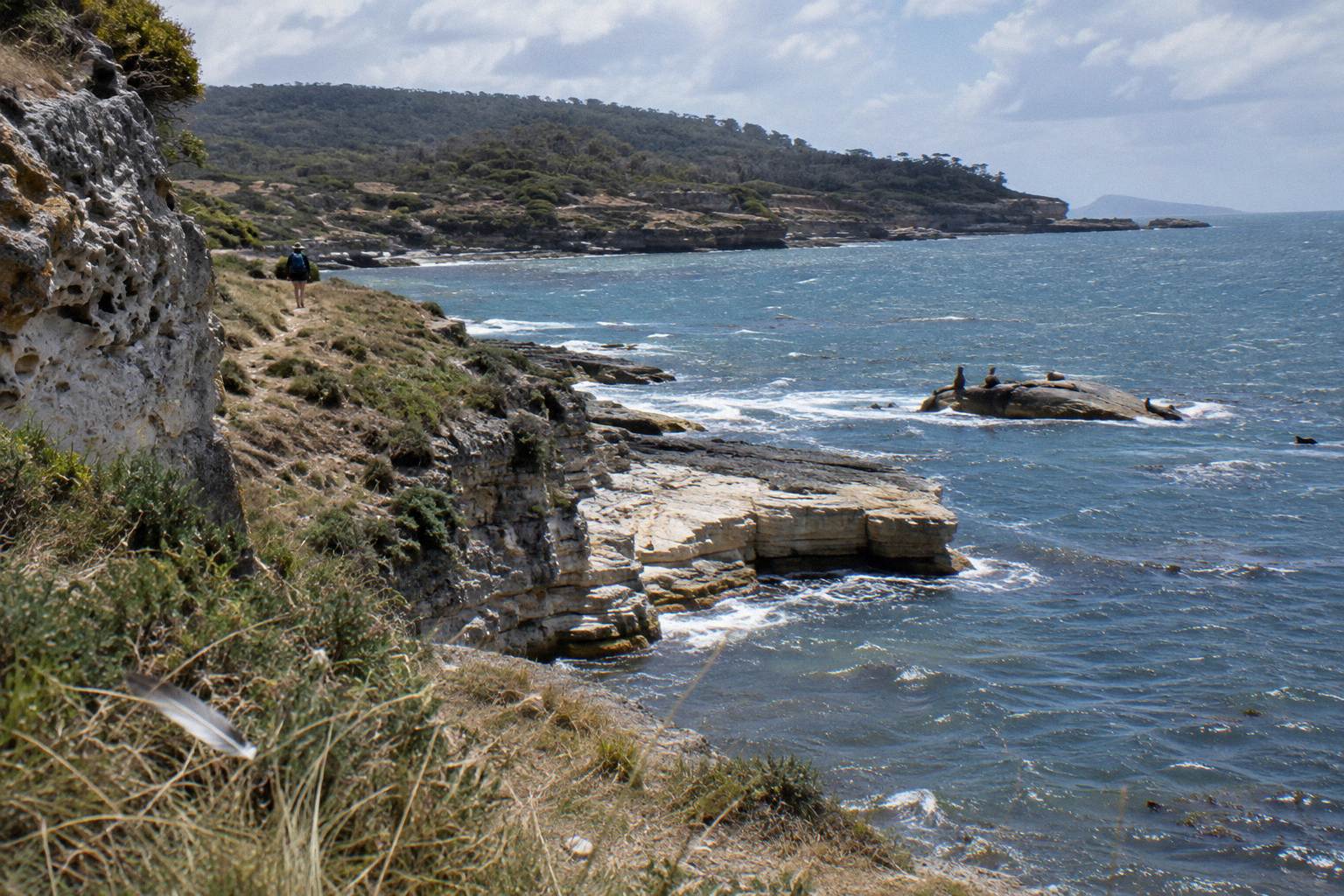
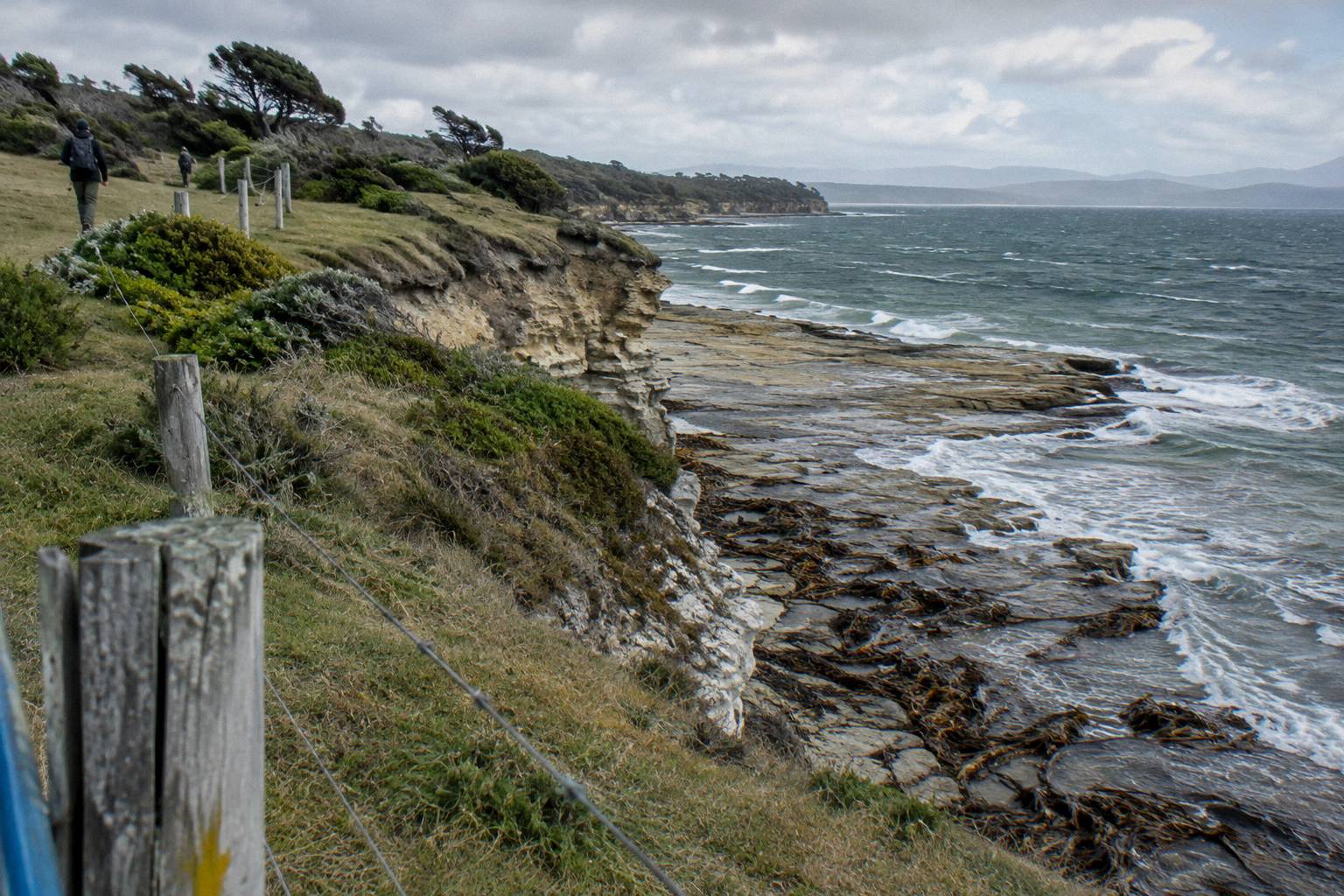
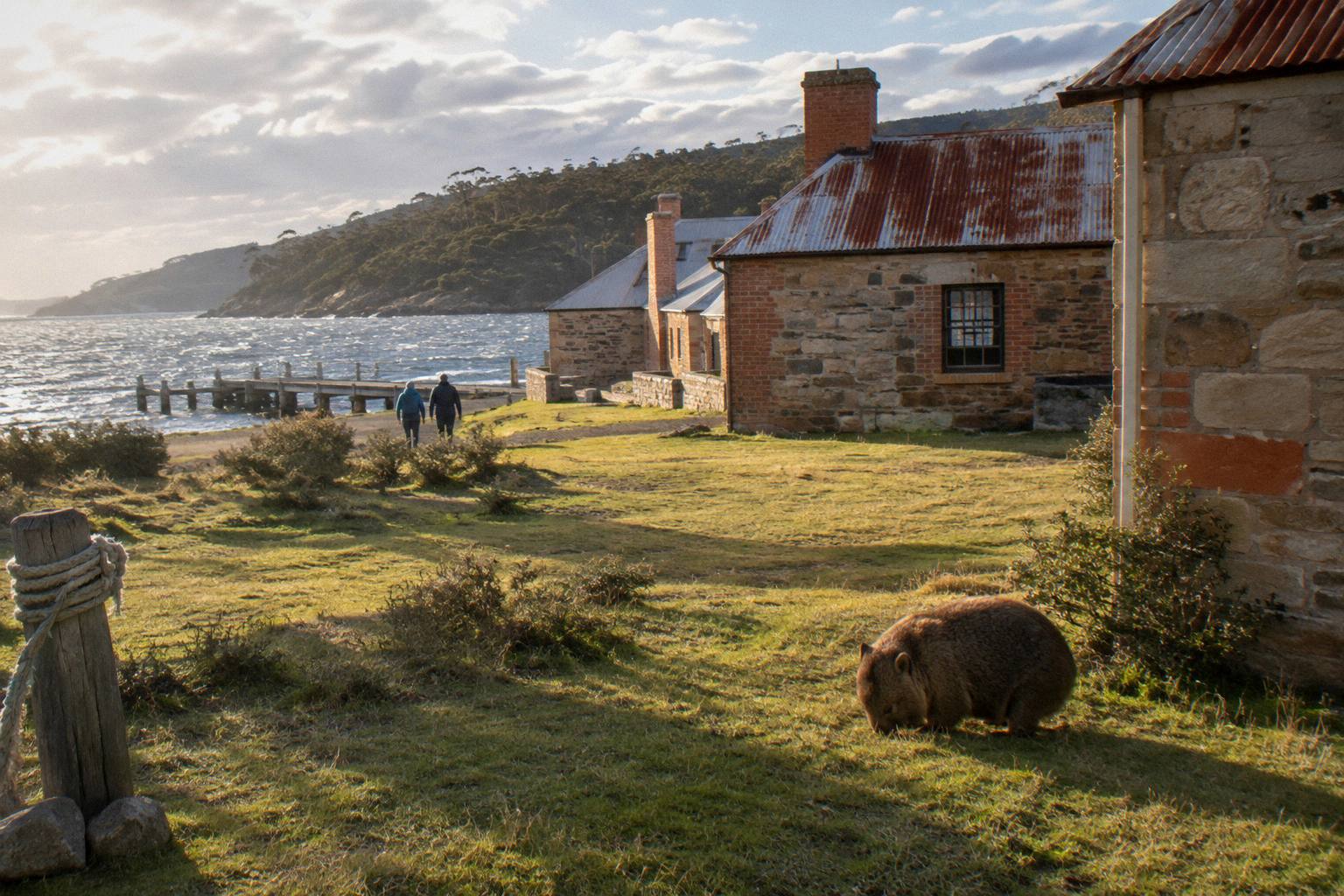
The eastern shoreline section carries the views. From the higher ground the water opens out toward the horizon, and on clear days the light across the sea is the island's defining picture. The return leg is quieter, crossing ground where wildlife often appears in the early morning and late afternoon. Parks asks all visitors to keep 2 metres from wildlife and never to feed it, and that rule applies along the whole circuit.
Two practical notes shape the experience. First, the cliffs are a look-at, not a climb: stay on the formed track and respect the barriers of terrain and safety sense. Second, the shoreline below is unpatrolled and conditions vary, so treat any beach section with ordinary coastal caution. The walk is about the cliffs and the circuit, not about swimming.
Walking It From Darlington: Route, Direction And Timing
Most walkers reach the Fossil Cliffs track directly from Darlington, either as a standalone circuit or as the first stop of a bigger day. Walking anticlockwise, out along the coast first, puts the cliff sections earlier while legs are fresh. Allow 1 to 2.5 hours for the circuit itself, plus whatever time you spend stopped at the fossils.
Direction is a genuine choice. Going out along the coast first means you carry the views and the fossil stops into the first half, then finish on the flatter inland return when energy is lower. Reversing it gives you a warm-up before the cliffs and pushes the scenic pay-off to the end. Both directions cover identical ground; there is no access difference between them, unlike the Painted Cliffs where tide timing governs the safe window.
Timing around your arrival matters more than direction. Ferry arrivals land at Darlington from mid-morning, and cruise-based day tours typically give their guests roughly two hours on the island with a guided Darlington walk. Two hours is enough for the Fossil Cliffs circuit at a steady pace, but not enough for it plus the Painted Cliffs. Visitors with a full day, or those on a ten-hour guided day from Hobart, can do both and still eat lunch.
If you are weighing a self-guided day against a guided one, the decision usually comes down to transport and inclusions rather than the walk itself. The ferry from Triabunna gets you there independently with a same-day return from A$59.00 per adult, fares change, while guided days bundle the crossing, the park entry and a leader. Both routes put you on the same Fossil Cliffs track.
Guided days that start in Hobart remove the driving question entirely. The Active Day Tour From Hobart runs about 10 hours with a Hobart start on Davey Street, ferry and park fees included, about 10 km of walking at a moderate fitness level in a small group, rated 4.8 from 240+ reviews, and returns to Hobart; cancellation terms differ between its booking pages, so check the terms on the booking page you use. Check availability
Fossil Cliffs On Foot Or By Bike
Walking the circuit takes 1 to 2.5 hours; riding it takes 1 to 1.5 hours, and Parks permits bikes on this track unlike the walking-only tracks elsewhere on the island. Hire bikes are available on the island from A$40 a day for an adult, booked at least 24 hours ahead. The bike wins time; feet win the fossil stops.
The time difference is modest on a 4.5 km circuit, so the real question is what kind of day you want. A bike compresses the Fossil Cliffs loop and frees time for a second destination, which matters if you want to reach the Painted Cliffs or the Reservoir Circuit on a single-day visit. On foot, the same loop fills a comfortable middle chunk of the day with stops built in.
| On foot | By bike | |
|---|---|---|
| Time for the circuit | 1 to 2.5 hours | 1 to 1.5 hours |
| Fossil stops | Unrestricted, stop anywhere | Stop only where safe to dismount |
| Fitness needed | Basic, Grade 3 | Comfortable riding on formed track |
| Best for | Photographers and fossil spotters | Visitors combining two or more tracks |
Hire details come from the ferry operator's island service: hard trail mountain bikes in sizes for riders from 7 years, helmet supplied, collected next to the penitentiary in Darlington, adult hire from A$40 per day or part, and children's rates lower; fares and fees change. Book at least 24 hours ahead, because the fleet is finite on busy summer days. Bikes are not permitted on walking tracks, so the Fossil Cliffs circuit and the island's other shared tracks are where a bike earns its keep.
Which Guided Day Tours Include Time On The Island Walks?
Three of the ten bookable day trips fit a walking-focused visit: the Active Day Tour From Hobart, the Grand Picnic Day Walk, and the Cruise And Walk From Hobart. Each includes the park entry fee, each starts from Hobart, and each gives you hours on the island rather than a fly-past. The right one depends on pace, group size and price tolerance.
The Active Day Tour From Hobart is the walkers' pick of the Hobart departures. It runs about 10 hours with about 10 km of walking at moderate fitness, in a small group, with ferry and park fees included and a Hobart pickup on Davey Street, an earlier start in summer than in winter. It suits visitors who want the walking to be the point of the day. Other pages covering the same trip are gathered on Maria Island Tours.
The Grand Picnic Day Walk, run by See Tasmania Tours, also runs about 10 hours with Hobart hotel pickup and a Davey Street start around 8:15am. Land and sea transport and park fees are included, the group is capped at a maximum of 8, and free cancellation applies up to 24 hours before start. The price for your date shows on the booking page. It suits visitors who prefer a small group and a long lunch over maximum kilometres.
The Cruise And Walk From Hobart takes a different route to the island entirely: a 7:45am check-in at Franklin Wharf in Hobart, a bus to Triabunna, then the operator's own cruise rather than the public ferry. Park entry is included, free cancellation applies up to 24 hours before start, the meeting point shows at booking, and it is rated 5.0 from 630+ reviews. Prices start at A$365 per adult on the operator site, amounts in Australian dollars, and change with season. See the Cruise And Walk From Hobart for the current calendar.
A fourth option suits visitors already staying near Triabunna. The Cruise And Walk From Triabunna starts at 21 Vicary Street with check-in around 9:30am, runs about 6 to 8 hours, includes the landing and park fee, and carries a 5.0 rating from 230+ reviews, with free cancellation up to 24 hours before start. It skips the Hobart transfer and gives those hours back to the island.
Combining The Fossil Cliffs With Other Walks In One Day
The Fossil Cliffs circuit pairs naturally with the 1 km Darlington Township Walk for a short day, with the 4.3 km Painted Cliffs return for the classic double, or with the 4 km Reservoir Circuit for a full circuit day. Most day visitors manage the township walk plus one of the three short circuits; two big walks need a full day and early legs.
The combinations are the heart of day-trip planning, because every visitor's clock is set by the last sailing or the tour departure. The table below uses Parks walking times and distances for each individual walk. Add your stops, your lunch and the walk between the jetty and the track heads on top.
| Combination | Second walk distance | Parks walking time, both walks | Fits a standard day visit? |
|---|---|---|---|
| Fossil Cliffs plus Darlington Township Walk | 1 km | 1.5 to 4.5 hours | Yes, comfortably |
| Fossil Cliffs plus Painted Cliffs | 4.3 km return | 2 to 4.5 hours | Yes, with tide care at Painted Cliffs |
| Fossil Cliffs plus Reservoir Circuit | 4 km return | 2.5 to 4 hours | Yes |
| Fossil Cliffs plus Bishop and Clerk | 11 km return | 5 to 7.5 hours | Only on a long day, strong walkers |
The Painted Cliffs double deserves its caveat. That walk's rock platform is safest within two hours of low tide and in calm seas only, the cliffs cannot be climbed or reached from above, and the timetable knows nothing about tides. Check the tide before you promise yourself both headlands in one afternoon; the details are in the Painted Cliffs walk guide.
Bishop and Clerk in the same day as Fossil Cliffs is possible for strong walkers, but it is a different kind of day: 11 km return, Grade 4, a 620 m summit, scrambling and exposure. Treat that column of the table as a stretch goal, not a default.
Food, Water And What To Carry On The Circuit
There are no shops or cafes on the island, so every meal, snack and drink for the walk is carried in. Water at Darlington is not potable and must be boiled for one minute or purified before drinking, with a few signed taps at the barbecue shelter and Mess Hall. There are no rubbish bins anywhere, so everything you bring leaves with you.
A day built around the Fossil Cliffs circuit needs lunch, snacks, more water than you think, sun protection for the exposed eastern sections, and a bag for your own rubbish. Layered clothing matters too: the coastline is open to weather off the sea, and conditions change fast.
Visitors on guided days get part of this solved for them. The Grand Picnic Day Walk's transport and park fees are in its price, and walkers carry only what the day needs. Independent visitors coming across on the ferry handle all of it themselves, and the packing guide for a Maria Island day tour covers the full checklist, including bedding-free day-trip specifics.
One more rule worth repeating: fishing is not allowed in the no-take marine zone along the north-west coast, and collecting shells or any living or dead material is prohibited. The fossil beds are for looking at, and the shoreline is for leaving as you found it.
Tides, Safety And Respect On The Cliff Sections
The Fossil Cliffs walk, unlike the Painted Cliffs, has no tide-dependent access window: the circuit can be walked at any tide. The safety notes that matter are ordinary coastal ones, unpatrolled beaches, unstable cliff edges, and keeping 2 metres from wildlife. The cliff face itself cannot be climbed or dug into, and fossils must stay in the rock.
That tide point is the single most useful planning difference between the island's two famous short walks. Visitors sometimes assume both cliff walks are tide-bound; only the Painted Cliffs platform is. Fossil Cliffs is a Grade 3 upland circuit with the fossil face below it, so a midday arrival at any tide still gives you the full walk.
The standard precautions apply anyway. Stay on the track near the cliff edge, because the ground above drops away and the rock is unstable. Keep children close on the coastal sections. If you descend toward shoreline rocks, watch the sea, not just your footing, and never turn your back on the water. Beaches on the island are unpatrolled, so swimming decisions are personal ones made without lifeguards.
Finally, the fossil beds are protected by the same national park rules that govern the marine reserve. Looking, photographing and wondering are unlimited. Removing, chipping or collecting is not, for fossils or for shells.
A Short History Of The Ground Under Your Feet
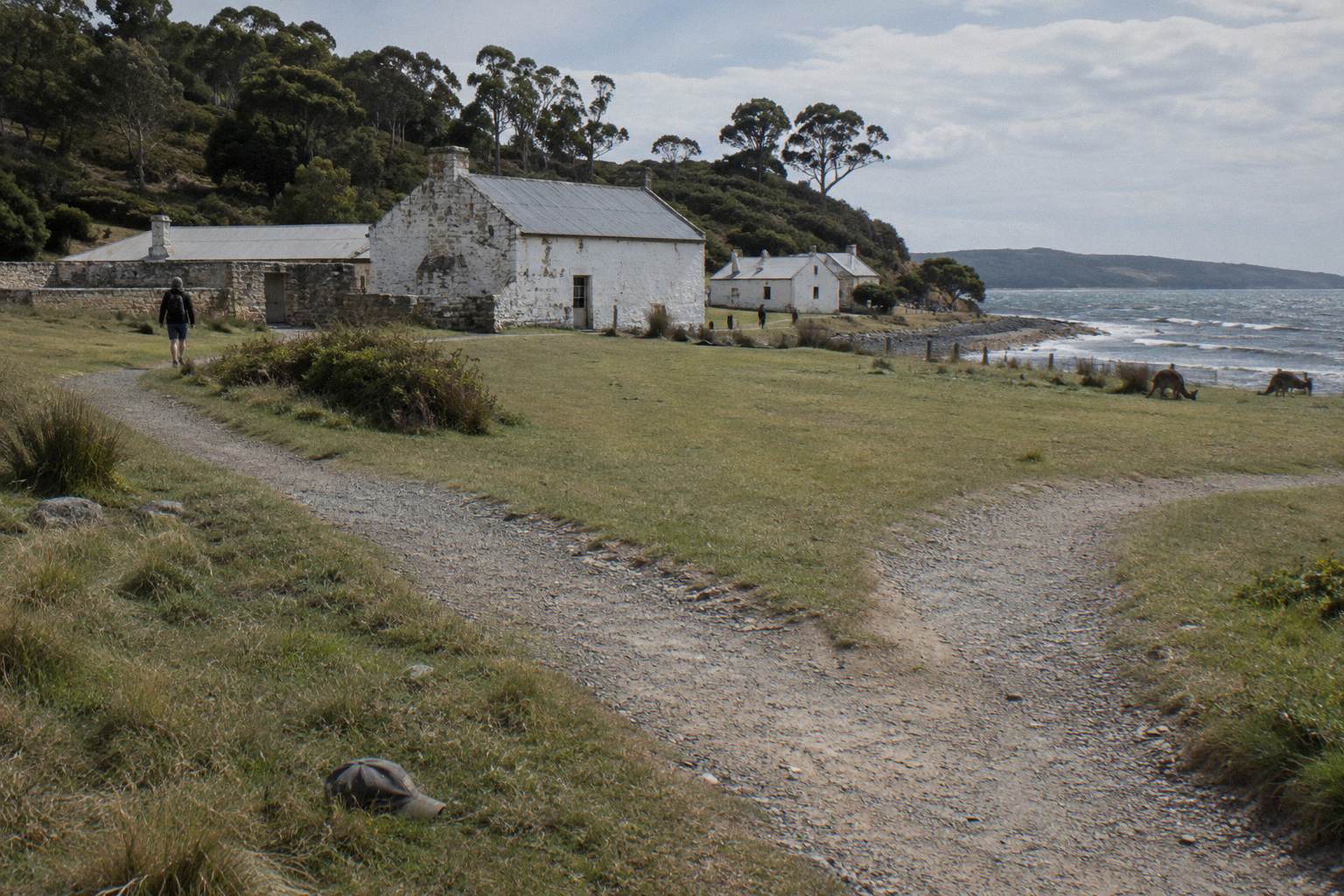
The fossils are about 300 million years old, the island became a national park in 1971, and Darlington's convict buildings date from 1824, with the penal settlement from 1825. The circuit walks you across both timelines at once: ancient fossil beds below, colonial ruins at the start and finish. Wikipedia records the island's size at 115.5 square km, 20 km long, with Mount Maria the high point at 711 m.
What makes the Fossil Cliffs circuit unusual among short Australian walks is that double frame. Most short walks give you one thing; this one gives you a cliff face holding remains older than the dinosaurs and, twenty minutes later, a World Heritage-listed convict precinct. Darlington was inscribed in 2010 as part of the Australian Convict Sites, and Parks describes it as the most intact convict probation station in Australia.
The island's broader story, Aboriginal connections over more than 35,000 years, the penal decades, the Bernacchi industrial experiments, sits behind every track junction. For the walk-specific detail, the Wikipedia article on Maria Island is a solid overview, and the Parks page carries the official track and safety notes.
You do not need any of this history to enjoy the circuit. But knowing the rock below you is 300 million years old, and the ruins beside the jetty are 200, changes how a 4.5 km loop feels underfoot.
What Trips People Up On This Walk
The recurring mistakes are assuming the walk needs a low tide, planning both cliff walks with no tide check, arriving without food or drinkable water, and underestimating the last ferry or tour departure. None of these are dangerous in themselves, but each one has cost visitors a headland, a lunch or a night they did not plan for.
The tide confusion runs both directions. Some visitors skip the fossil circuit on a high tide, wrongly, since it has no tide gate. Others stack the Painted Cliffs onto the same afternoon without checking when low tide falls, then find the platform window shut. The fix is one glance at a tide chart before the day starts.
The food mistake is the most common. The island sells nothing, the taps need a boil, and a warm afternoon on an exposed circuit empties bottles faster than expected. Pack as if the island were a boat: everything aboard, everything off again.
The clock mistake is the costliest. The ferry's return sailings and every tour's departure time are fixed, and the walk back from the far side of the circuit takes longer than tired legs expect. Set a turn-around time at the fossil face, not at the far end of the loop.
Common Questions About The Fossil Cliffs Walk
How Long Is The Fossil Cliffs Walk On Maria Island?
The circuit is 4.5 km from Darlington and takes 1 to 2.5 hours on foot, or 1 to 1.5 hours by bike. Parks lists both walking and riding times, and the slow end of the walking range reflects a family pace with stops at the fossil face.
Is The Fossil Cliffs Walk Hard?
No, it is rated Grade 3: a formed track with some steps and short steep sections. Most visitors with basic fitness complete it comfortably. It is easier than the Grade 4 Bishop and Clerk walk, which involves 11 km of return walking, scrambling and a 620 m summit.
Do You Need Low Tide For The Fossil Cliffs?
No. Unlike the Painted Cliffs, where the rock platform is safest within two hours of low tide and in calm seas, the Fossil Cliffs circuit is an upland track with no tide-dependent access. It can be walked at any tide.
How Old Are The Fossils At Fossil Cliffs?
About 300 million years old. The remains are embedded in the cliff face below the track and are visible without any specialist knowledge. Collecting or chipping at the fossil beds is prohibited; they stay in the rock.
Can You Combine Fossil Cliffs And Painted Cliffs In One Day?
Yes, on a full day visit. The two circuits together take 2 to 4.5 hours of walking at Parks times. The one planning step that matters is checking the tide for the Painted Cliffs platform, which is safest within two hours of low tide and in calm seas only.
Do Any Guided Tours Include The Island Walks?
Yes. The Active Day Tour From Hobart includes about 10 km of walking over roughly 10 hours with ferry and park fees included; the Grand Picnic Day Walk runs a similar day in a group of at most 8; and the Cruise And Walk From Hobart reaches the island by the operator's own cruise rather than the ferry, with park entry included.